Three Monetization Bets to Make or Break Your 2026
What to do when your best paywall stops winning: three monetization strategies that still move ARPU for subscription apps in 2026.

Run paywall experiments for long enough and you eventually hit a wall: the winning design keeps winning, and every new variation lands inside the margin of noise. That is where Nick Godwin, head of customer growth and product, found himself at the start of this year. At Superwall, he runs around 200 experiments annually across roughly 60 large and hyper-growth apps, and the design-your-trial paywall had been so durable across app categories that improving on it felt like spinning in place.
In a recent office hours session, Nick walked through the thesis he landed on after hitting that wall, and the three bets he thinks separate apps that grow in 2026 from apps that plateau.

2026 monetization bets overview
| Bet | What it helps you do | Best first test | Watch out for |
|---|---|---|---|
| AI-assisted analytics | Ask deeper revenue questions across paywall, onboarding, pricing, and retention data | Use an agent to find which user segments drive ARPU, trial-to-paid, and retention | The answer still needs row-level review before you act on it |
| Full-funnel personalization | Route users through different onboarding and paywall paths based on intent and behavior | Segment users by the inputs that actually correlate with conversion or revenue | Too many onboarding questions can create friction for low-intent users |
| App-to-web checkout | Move qualified users into web payment flows when the economics justify it | Test web checkout on segments where Stripe friction is less likely to hurt conversion | Apps on Apple’s Small Business Program may net out roughly flat |
How can AI agents make monetization analysis faster?
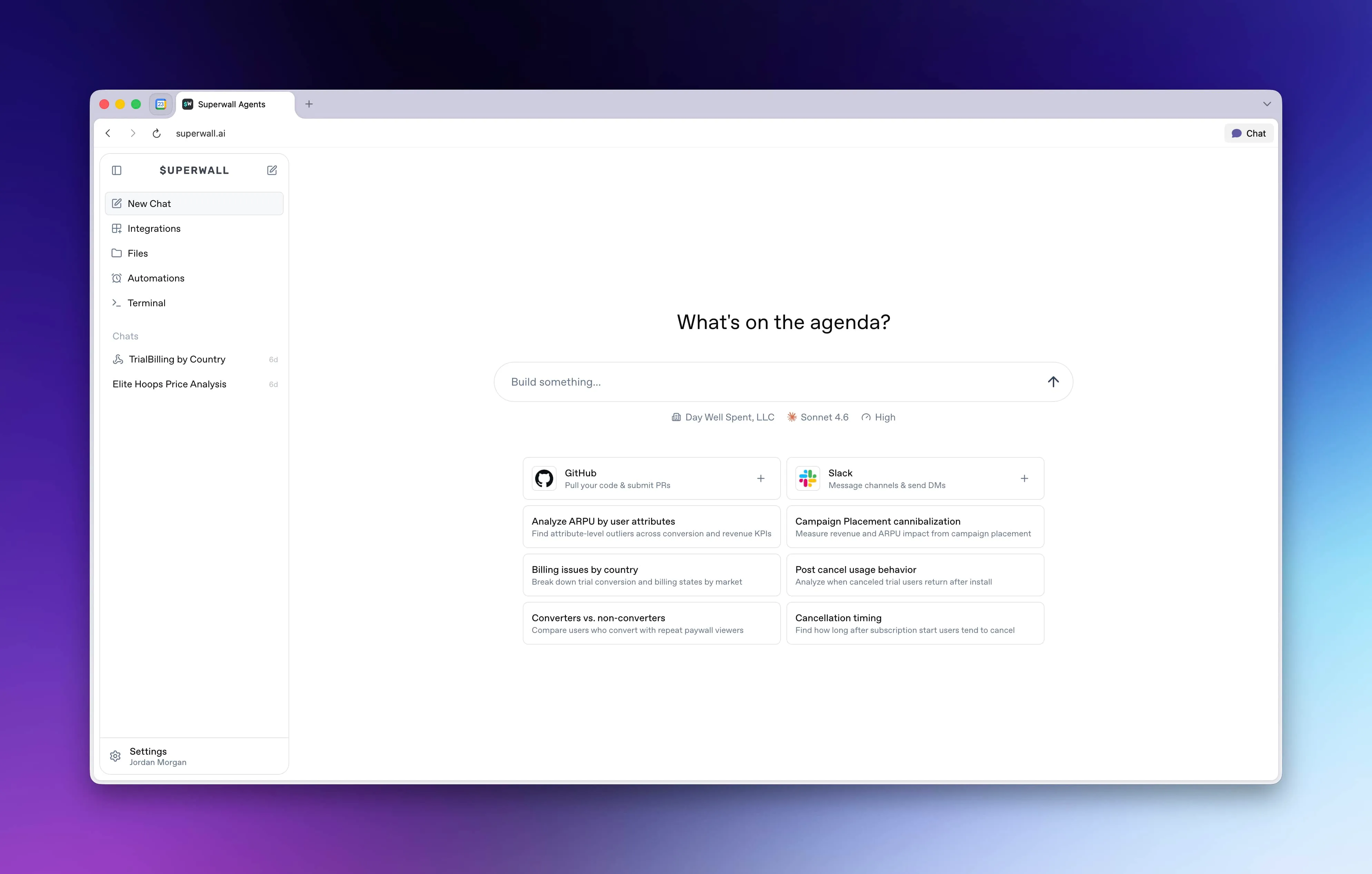
The first bet is freeform analytics, shorthand for using an AI agent to ask the kind of questions a dashboard was never built to answer. With the quickly shifting landscape of AI, a fantastic use case has emerged: deploying these LLMs on as much of your app’s data as you can.
Why? Because answering in-depth questions across several different data domains becomes as easy as a prompt. Questions that took a fair bit of digging are accessible now, such as:
- Are my special-offer paywalls cannibalizing revenue or are they actually additive?
- Which price variant is the net ARPU winner across multiple touchpoints?
- Which combinations of onboarding inputs correlate with the highest conversion rate, ARPU, and retention?
On a normal dashboard you need to know your own event taxonomy, find the exact chart, pull the right filters, and QA the output. With an agent, you can ask in plain language and get a defensible answer in minutes.
When polled on what they use for deep monetization analysis, Amplitude led at 41%, with Mixpanel and PostHog tied at 24%. Zero people picked Claude, Codex, or another agent. Superwall.ai is built for exactly this kind of analysis. It shows its work, hands you the underlying CSV so you can vet the rows yourself, and lets you refine the prompt in conversation when it misreads your intent on the first pass.
How should subscription apps personalize the whole funnel?
Personalization usually gets watered down to mean “tweak a paywall headline.” Nick’s version goes further. To Nick, personalization means routing users through fundamentally different onboarding and paywall flows. Intent and behavior should drive the segmentation, while demographics should support it only where they help.
A few examples from the session:
- AI phone assistant app: Work status was their single biggest differentiator. Business owners and self-employed users had an 85% higher conversion rate and accounted for 75% of realized revenue, which meant the team could put its experimentation effort exactly where the money was.
- Restaurant menu guide: Users who eat out three-plus times a week converted so quickly that a long design-your-trial offer underperformed a tighter three-day trial at higher pricing for that segment.
- Gym app: Ranked acquisition source, user goal, and experience level as their top three RPU drivers, then built distinct onboarding flows and UGC hooks around the resulting archetypes.
- Social app: Opened with 12 onboarding questions but found only three actually correlated with conversion. Cutting the rest lifted onboarding completion materially for low-friction segments, while the longer flow stayed in place for users who genuinely needed it.
When does app-to-web checkout make sense?
Web to app and app to web can be valuable tools in your monetization efforts, but neither one should be treated as a silver bullet. Bet three was centered around web payments.
Nick has run app-to-web experiments with more than 50 customers, and his pushback on how most teams approach it bears repeating. App-to-web should not be treated as one giant lever for the whole user base. Wiring up a Stripe checkout and hoping it lifts revenue everywhere is the wrong move. Use freeform analytics to find the segments where web checkout actually fits: qualified users where Stripe friction will not stop them, churned users you are retargeting via email, and organic-search traffic that arrived as comparison shoppers rather than through an ad.
If you dive into the numbers a bit, most would agree that the economics are what make the bet worth running. Initial conversion versus in-app purchase can drop by as much as 37% because of the added Stripe friction, but trial-to-paid lift usually runs 50% or higher, and average ARPU lifts land in the 11% to 27% range.
Web-to-app is a longer build, but the cannibalization fear that holds most teams back is mostly unfounded. The overlap between users who would have converted in-app versus through a web funnel is only 5% to 7%, meaning these are different users you were not reaching anyway. Pick a formula that is already working for someone, start collecting data, and worry about segmenting your funnels once you have the volume to do it well.
What should mobile app teams do next?
Segment first, optimize second is the thread running through all three bets. Freeform analytics is how you find the segments. Personalization is how you treat them differently once you have them. App-to-web is one of the higher-margin levers you can pull for the segments that respond to it. Any one of the three should move your numbers, but if you stack them together then the compounding starts.
Where can you watch the full session?
The design-your-trial paywall template Nick referenced lives in the high-converting templates group in the Superwall library if you want to test it before anything else. And if you have questions about wiring any of these bets up in Superwall, the team is around. Drop into the next office hours and bring them.
Want the slides from the session? Grab them here.
FAQ
- What are the highest-leverage monetization bets for subscription apps in 2026?
- The highest-leverage bets are AI-assisted analytics, full-funnel personalization, and app-to-web checkout for the right user segments. Each bet helps teams move beyond small paywall design changes and find bigger revenue opportunities in segmentation, pricing, and payment flow strategy.
- Why do paywall experiments start to plateau?
- Paywall experiments plateau when a winning design keeps outperforming alternatives and new variations land within the margin of noise. At that point, the next lift usually comes from finding better segments, changing the user journey, or testing a different checkout path rather than making another surface-level design change.
- How can AI agents help with mobile app monetization?
- AI agents can help teams ask plain-language questions across paywall, onboarding, pricing, and retention data. They are most useful when they show their work, expose the underlying rows, and let teams verify the answer before making a product or growth decision.
- When should an app personalize more than the paywall?
- An app should personalize more than the paywall when different user groups show meaningfully different intent, behavior, conversion rates, or revenue potential. In those cases, routing users through different onboarding and paywall flows can work better than showing everyone the same offer with a slightly different headline.
- When is app-to-web checkout worth testing?
- App-to-web checkout is worth testing when the target segment is qualified enough that Stripe friction will not erase the economic upside. It is especially worth exploring for retargeted users, comparison shoppers, and segments where web payments can lift trial-to-paid rate or ARPU.
- Should every subscription app move payments to the web?
- No. Apps on Apple's Small Business Program may find that app-to-web checkout nets out roughly flat because they already pay a lower platform fee. Most teams should test app-to-web on specific segments first, then expand only if the data shows better revenue after accounting for conversion friction.