How an indie developer doubled revenue by switching back to Superwall
After a costly detour to a competitor's paywall tools, one solo iOS founder came back to Superwall and doubled revenue in six months with installs flat.

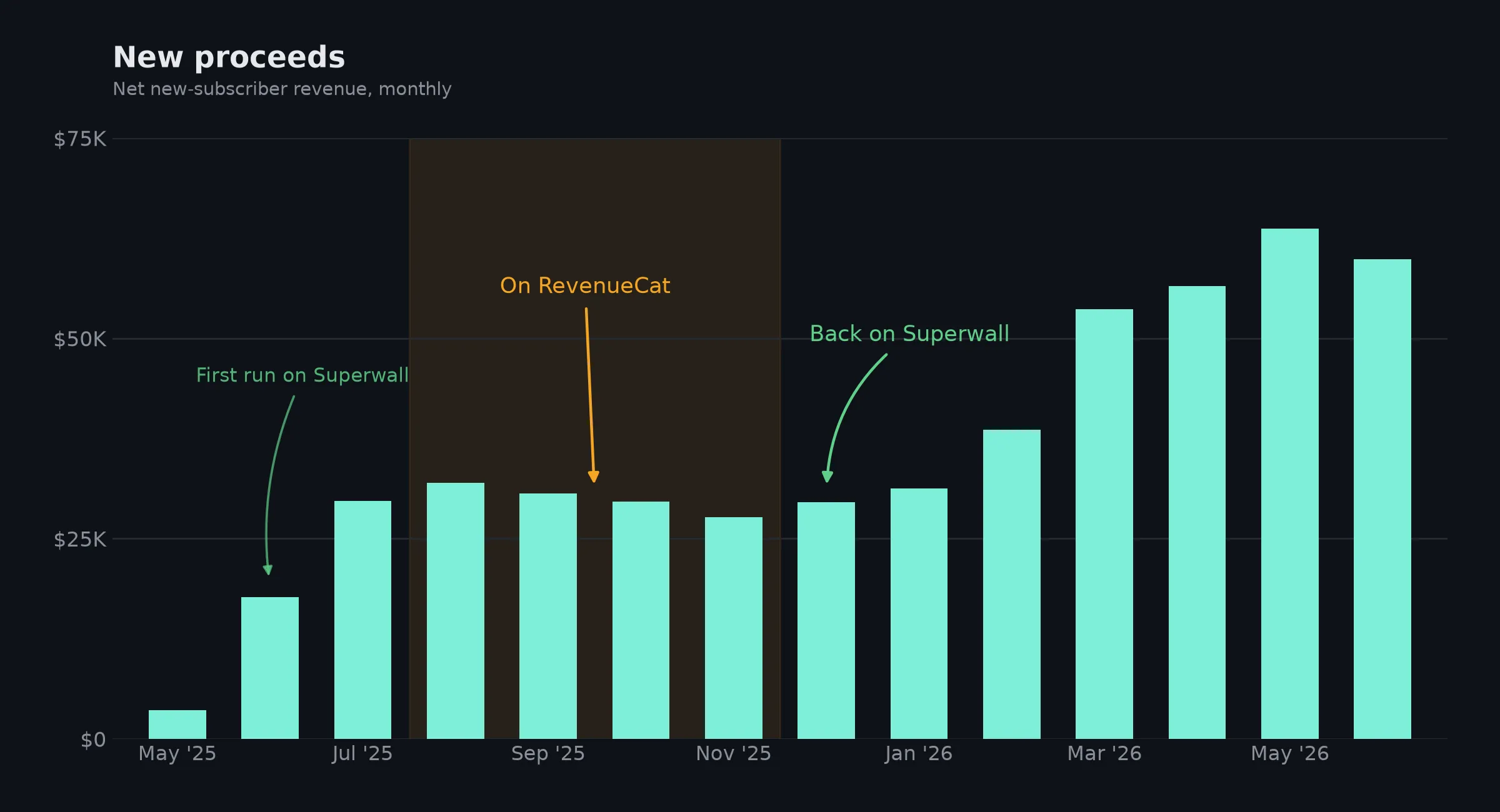
First run on Superwall
Sebastian joined Superwall in May 2025 and spent the next few months on fairly standard experimentation: weekly vs. annual pricing, discount flows, money-back guarantee messaging. The app was growing quickly.
The RevenueCat detour
In August 2025, RevenueCat had just launched its own native paywall product. Sebastian saw a chance to consolidate subscription management, paywalls, and experimentation into a single platform. It didn't go the way he expected.
The paywall and experimentation tools had real limits. Changes and experiment status didn't update clearly in real time. Targeting and placement configuration felt unintuitive, and there was no clean way to tell which paywall was actually live at a given placement. After several weeks he found the sharpest problem: some placements weren't showing a paywall at all. They'd been misconfigured, and nothing in the dashboard made that visible.
The most concerning part was that the problem was not immediately visible from the dashboard.
— Sebastian Szturo
New-subscriber revenue went flat for the four months he spent on RevenueCat. The topline number didn't crash, propped up by renewals from subscribers he'd already won. But the growth engine itself had stalled, and he'd lost the visibility and confidence to fix it.
Back on Superwall
Sebastian returned to Superwall in December 2025. The move reset his subscription bill along with everything else: entitlements, purchase handling, webhooks, and his own data run free at any scale on Superwall, so the flat RevenueCat cost went away, replaced by a cut of only the revenue a Superwall paywall actually generates.
New paywalls were live within days. The first thing he tried was Stripe web checkout, curious whether skipping the App Store entirely would beat rebuilding his funnel from scratch. It didn't: weekly subscriptions carry most of his revenue, so a small conversion dip cost more than any App Store fee it saved, and Stripe brought overhead of its own. He dropped it within weeks and turned that same appetite for testing onto everything else.
What drove the growth
The growth that followed came almost entirely from the product itself, not new users: onboarding, pricing, messaging, targeting, and the paywalls tying it together. Some of the specific moves behind it:
- Geo/parity pricing went live within the first month back
- Exit offers, launched in January 2026, grew into a full multi-variant, segment-specific system by June
- Onboarding went through several iterations between April and June 2026, each adding a new layer
- Superwall's growth service compounded it further: roughly 3x organically (Dec–Mar), then continued growth once Tangent joined in April 2026
Results
-
2x revenue: January to June 2026, with installs essentially flat.
-
30+ paywalls: shipped in the 7 months since returning.
-
~7x sessions: recovered from the RevenueCat-era collapse within months of switching back.
Superwall made this experimentation process dramatically easier.
— Sebastian Szturo
Owning the data
Superwall also gives Sebastian direct, read-only access to his own data through ClickHouse, plus Superwall Agents to help him read experiment performance faster. On RevenueCat, by contrast, he says the data felt locked behind exports and webhooks.
Superwall is much more than a paywall builder now, it's the core infrastructure of my business. The combination of its AI tools, direct access to my own raw data through ClickHouse, and the Superwall skill lets me understand and optimize my subscription business in ways that simply were not possible before. My data is open, accessible, and genuinely useful and that makes Superwall worth every cent.
— Sebastian Szturo
Migrating from RevenueCat to Superwall
This is the shift Sebastian made: Superwall covers what RevenueCat did (subscription management, entitlements, webhooks), and the billing works differently as a result. Infrastructure is free at any scale, and the only thing billed is the paywall product, at 1% of paywall-attributed revenue, in place of a flat platform fee.
Migrating is handled for you: SDK swap, subscription history, entitlement state, and webhooks, ported over rather than rebuilt by our engineering team. Read the migration guide or book a call with the team to talk it through.
Teams that want the experimentation handled too can bring in Superwall's growth team (the same Tangent team behind Sebastian's results) to run paywall tests for a flat monthly fee, no revenue share. Book a free monetization audit and let them run it for you.
 Cal AI
  Ahead App
  BuyBye